
A coffee table takes more abuse than almost any other piece in a home. Feet, mugs, laptops, remote controls, and the occasional person sitting on it. Which is why construction matters more here than styling.


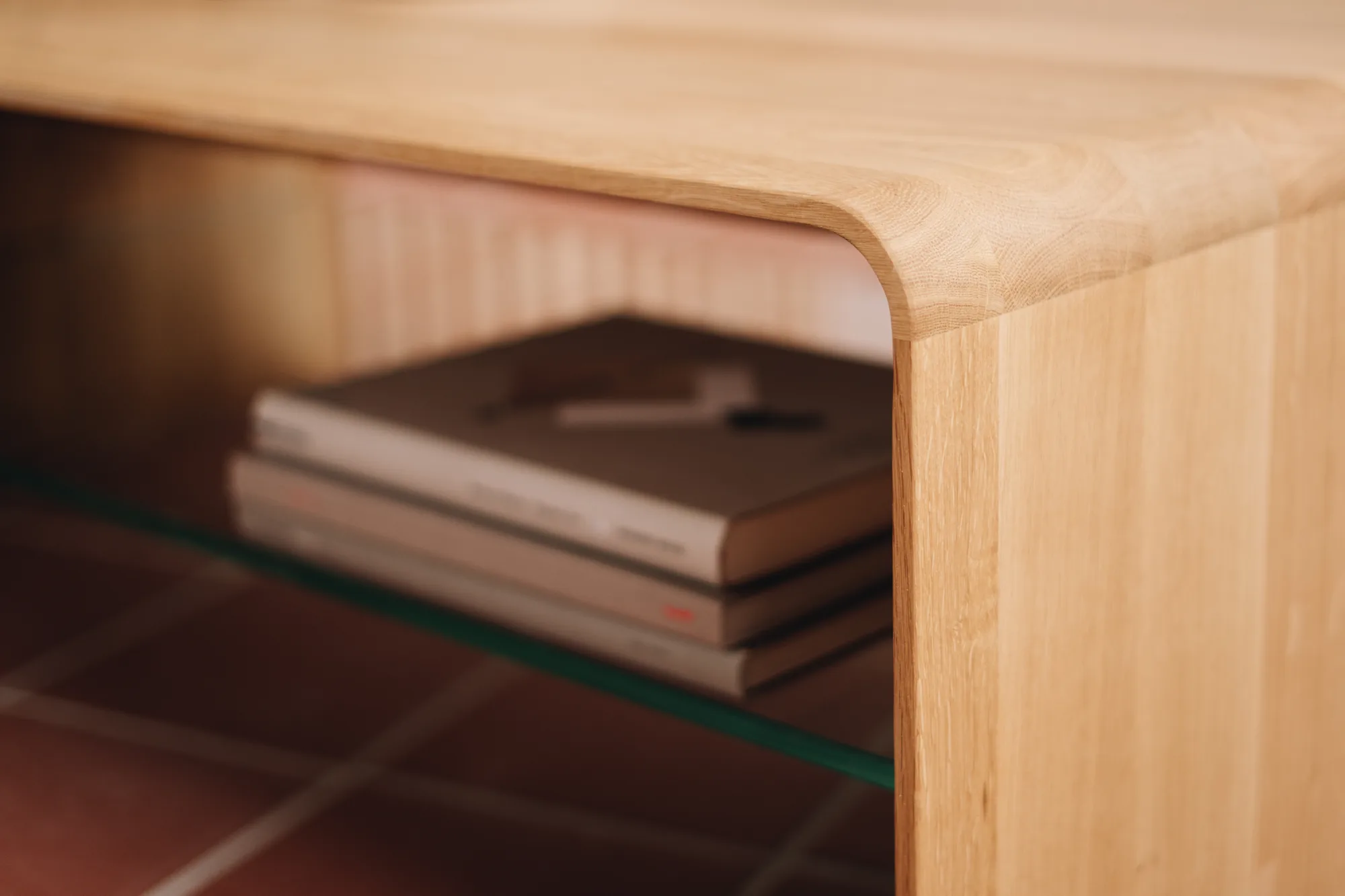
Solid oak means the component is cut from oak lumber all the way through. Veneer means a thin oak layer glued over a different core. That core is usually MDF, which is made from wood fibers, or particleboard, which is made from wood particles. Both are engineered panels, and they are not the same material.
The word "oak" in a product description does not tell you which one you are looking at. So look at the edge instead. On a solid top, the grain runs off the top surface, wraps over the edge and continues underneath.
On veneer it stops at a seam, and the edge is either a separate strip of banding or a printed pattern that does not line up with the face. You can usually see end grain on a solid top: short, dense, slightly different in tone from the face.
None of this makes veneer bad. It is a legitimate technique with real engineering uses, and over a stable core it will stay flatter than a wide solid board in some constructions. What matters is where solid wood is doing structural work, and whether the seller will answer that plainly.
Solid oak is heavy, and there is no way around it. European oak weighs roughly 45 pounds per cubic foot when dry, so a solid top measuring 48 × 24 inches at 1 inch thick lands around 30 pounds on its own, before the base.
If one person can lift the top comfortably with one hand, it is not solid oak at that thickness. That is arithmetic, not a marketing point, and it is the fastest check you have on a showroom floor.
One caveat: a slim visual edge can hide a thicker slab. Our OLIA table does exactly this, with a chamfered underside that reads light and weighs what solid oak weighs.
Leave 16 to 18 inches between the sofa and the table. Close enough to reach a cup without standing up, far enough that someone can walk past without turning sideways.
Run the table to about two thirds the length of the sofa. Shorter than half the sofa and the arrangement looks unresolved; longer than the sofa itself and the room loses its circulation.
Set the height level with the sofa seat, or up to two inches below it. A table taller than the seat makes a room feel crowded and makes reaching down awkward. Most seat heights fall between 16 and 18 inches, so measure yours rather than assuming.
With a sectional, size against the longest run and check the walkway on the open side first. That is where the layout usually fails.
Round works in tight rooms and in homes with small children. There are no corners at shin height, and you can walk around it from any direction. Round tops usually sit on a single central base, which frees up foot room.
The HRIB coffee table uses a turned central column with a rotating top, so a bowl or a tray can be passed across the table without anyone reaching. The XX round table takes the opposite approach, with an undulating sculpted base.
Rectangular gives more usable surface per square foot and reads calmer in a room with long straight lines: a long sofa, a run of shelving, wide windows. It also seats more people for a board game or a plate of food.
The XX rectangular table is the straightforward version; the JURO coffee table, designed by Tomáš Král, is the softer one, with a rounded top and a lighter frame.
If floor space is genuinely tight, two small tables often beat one large one. Push them together for a gathering and split them apart when you need the floor. Our TIN TIN table comes in three sizes for that reason.
If you need the surface to stay clear, choose a shelf over drawers, which are awkward to open from a seated position. An open shelf swallows magazines and remotes without adding hardware that can fail.
Ask one question about the finish: is there a protective layer over the oil? A plain oiled surface soaks into the wood and can be spot-repaired at home. A surface sealed with hardwax or lacquer resists damage better, but it cannot be touched up in one small patch.
This matters most on the pieces that get the hardest use, which is exactly why they are usually the ones with the extra layer. Our dining tables, coffee tables and nightstands leave the workshop with an additional hardwax coat over the oil, specifically to raise the surface's resistance.
The trade-off is that oil will not bond over that factory layer. Renovating one of these tops means sanding the whole surface evenly, removing the original coating and re-oiling from bare wood. It is a real job, not a twenty-minute touch-up, and the restored surface may not reach the resistance of the original factory finish. We would rather you called us before starting one.
So our home care package is not for coffee tables. It is for plain oiled pieces such as beds, wardrobes and shelving, where a ring or a light scratch really can be sanded back locally and re-oiled. Our care instructions set out which damage suits home repair and which does not.
None of which undoes the case for solid wood. A solid oak top has material to remove, so it can be sanded back and refinished more than once across its life. A veneered top has a paper-thin layer to work with, and once you sand through it the core underneath shows and the piece is finished. That is the difference that shows up in year fifteen.
Two things specific to oak, whichever finish you choose. Oak is high in tannic acid, so prolonged contact with wet iron, say a cast-iron trivet or a steel planter base, can leave dark blue-black marks that go deeper than the finish. And oak darkens under UV light, turning a warmer honey tone over the first few years. If you are matching a new table to older oak in the same room, expect the new piece to be lighter at first and to close the gap on its own.
Wood movement is driven by moisture content, which follows the relative humidity of the room. Temperature matters only indirectly, by changing that humidity. A top expands and contracts across the grain, not along it, and a wide solid oak top can move a meaningful fraction of an inch between a humid summer and a dry heating season.
Solid wood always moves. Any maker who tells you their solid oak is completely stable is either wrong or selling you a veneered panel. What separates good construction from bad is whether the joinery allows for it.
A top should be fixed to the base with elongated slots, buttons or figure-eight fasteners that let it slide; a top screwed rigidly to a frame eventually splits along the grain in the widest board.
So ask one question: how is the top attached to the base? A maker who builds for decades will answer it in a sentence. The workshop behind BeOak has been building furniture this way since 1947, and it is the single question we would want a customer to ask us.
For designers and architects working to a spec:
Request trade access through BeOak PRO.
Look at the edge of the top. On solid oak the grain runs off the top surface, over the edge and continues underneath, and end grain is visible at the short ends. On a veneered top the grain stops at a seam and the edge is banded or printed.
European oak weighs roughly 45 pounds per cubic foot when dry. A solid top of 48 × 24 inches at 1 inch thick therefore weighs around 30 pounds before the base is counted. If one person can lift the top with one hand, it is not solid oak.
About two thirds the length of the sofa, so roughly 54 inches. That proportion keeps the table anchored to the seating without blocking the walkway around it.
16 to 18 inches. That is close enough to set down a cup while seated and far enough for someone to walk past without turning sideways.
Level with the seat, or up to two inches below it. A table higher than the seat cushion makes the room feel crowded. Measure your own seat height, as it commonly ranges from 16 to 18 inches.
Round is usually better in a tight room: no corners at shin height, you can walk around it from any direction, and a central base leaves more foot room than four legs. Rectangular gives more usable surface, which matters more in a larger room with a long sofa.
No. Veneer is a legitimate construction technique, and a good veneered panel can stay flatter than a wide solid board. What matters is where solid wood is doing structural work, and whether the seller will tell you.
Not the way you would re-oil a bed frame. Coffee tables, dining tables and nightstands carry an additional hardwax layer over the oil, and fresh oil will not bond over it. Renovation means sanding the whole top evenly back to bare wood before re-oiling, so ask the maker before you start.
On a plain oiled surface, sand the mark lightly along the grain and re-oil that area. On a top sealed with hardwax or lacquer, a local repair will show, so contact the maker instead of treating it at home. Wiping spills as they happen prevents almost all of these marks.
It can, if the top is fixed rigidly to the base. Solid wood expands and contracts across the grain as the room's relative humidity changes, and the joinery has to allow for that. Tops attached with elongated slots, buttons or figure-eight fasteners move freely and will not split.
None of these checks work from a photograph. Book a visit to a BeOak showroom to lift a top, look at an edge and compare the oil finishes side by side, or browse the full range of solid oak coffee tables first.