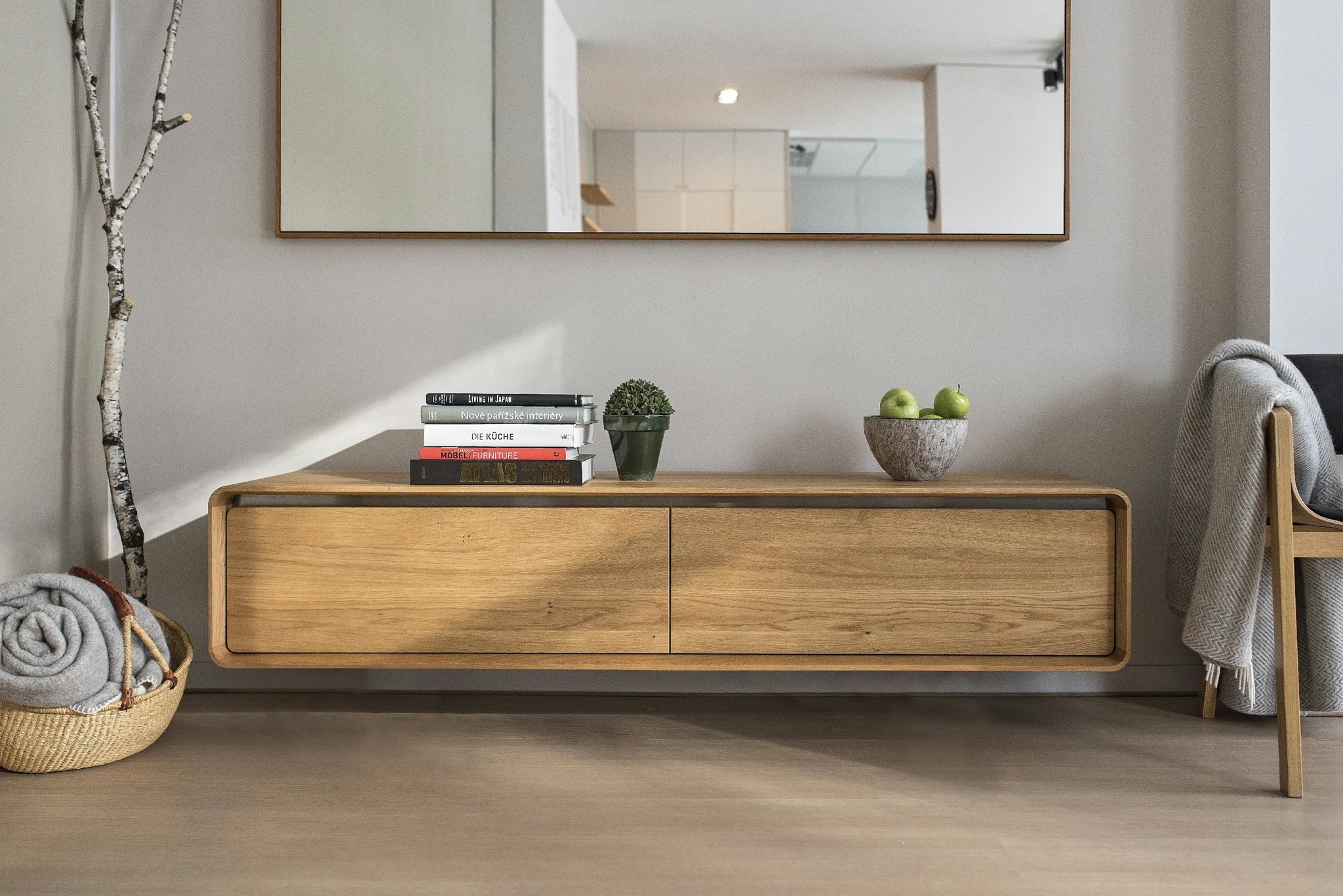
A media console is one of the few pieces in a living room that has to answer to a spec sheet. The screen has a width, the components have a depth, the cables need a route out the back, and the wall behind it may or may not hold weight. This guide covers how to size a solid oak TV stand to a specific screen, when wall mounting is worth the extra work, and how to read a product page closely enough to know whether you are buying solid oak or oak-coloured board.
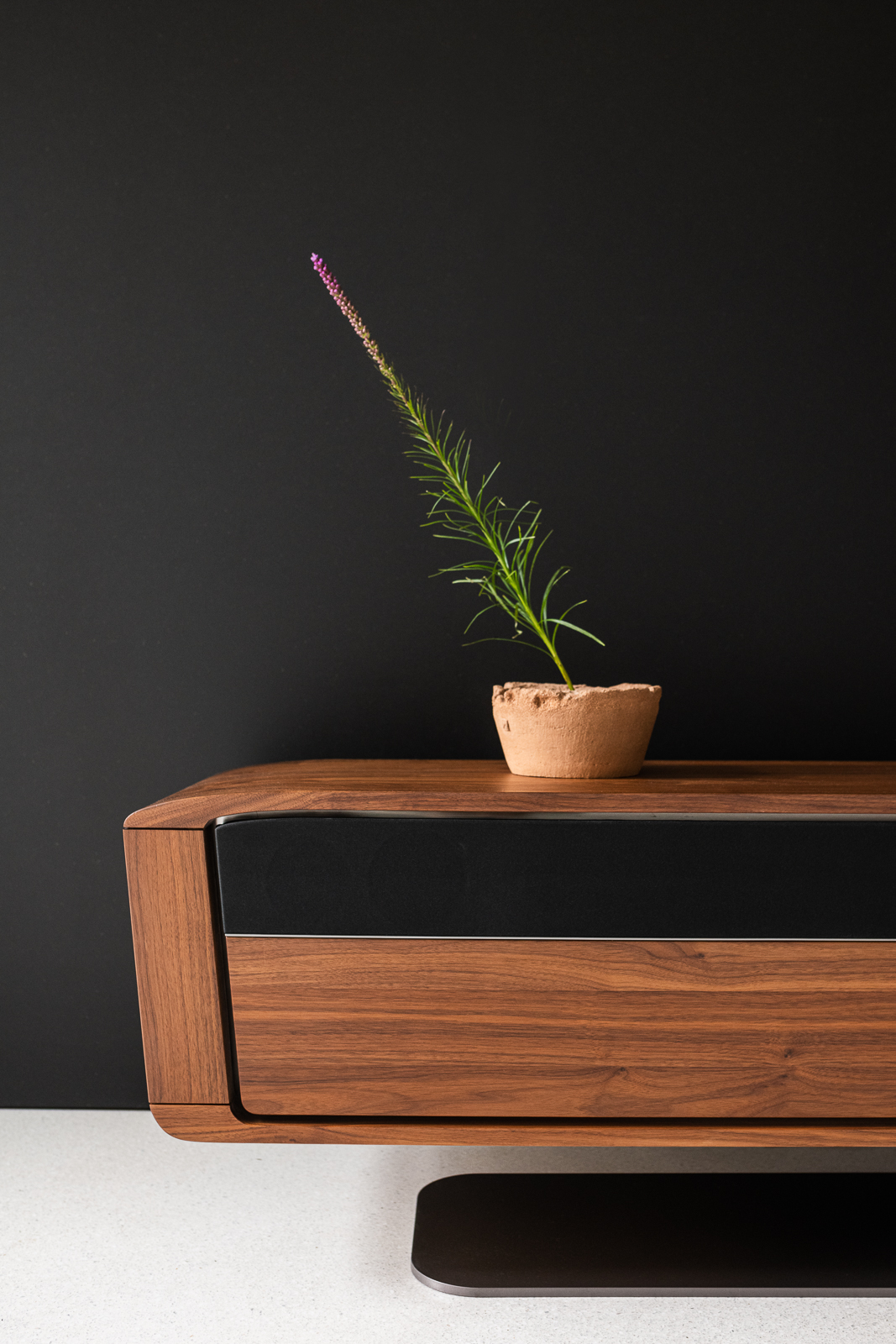
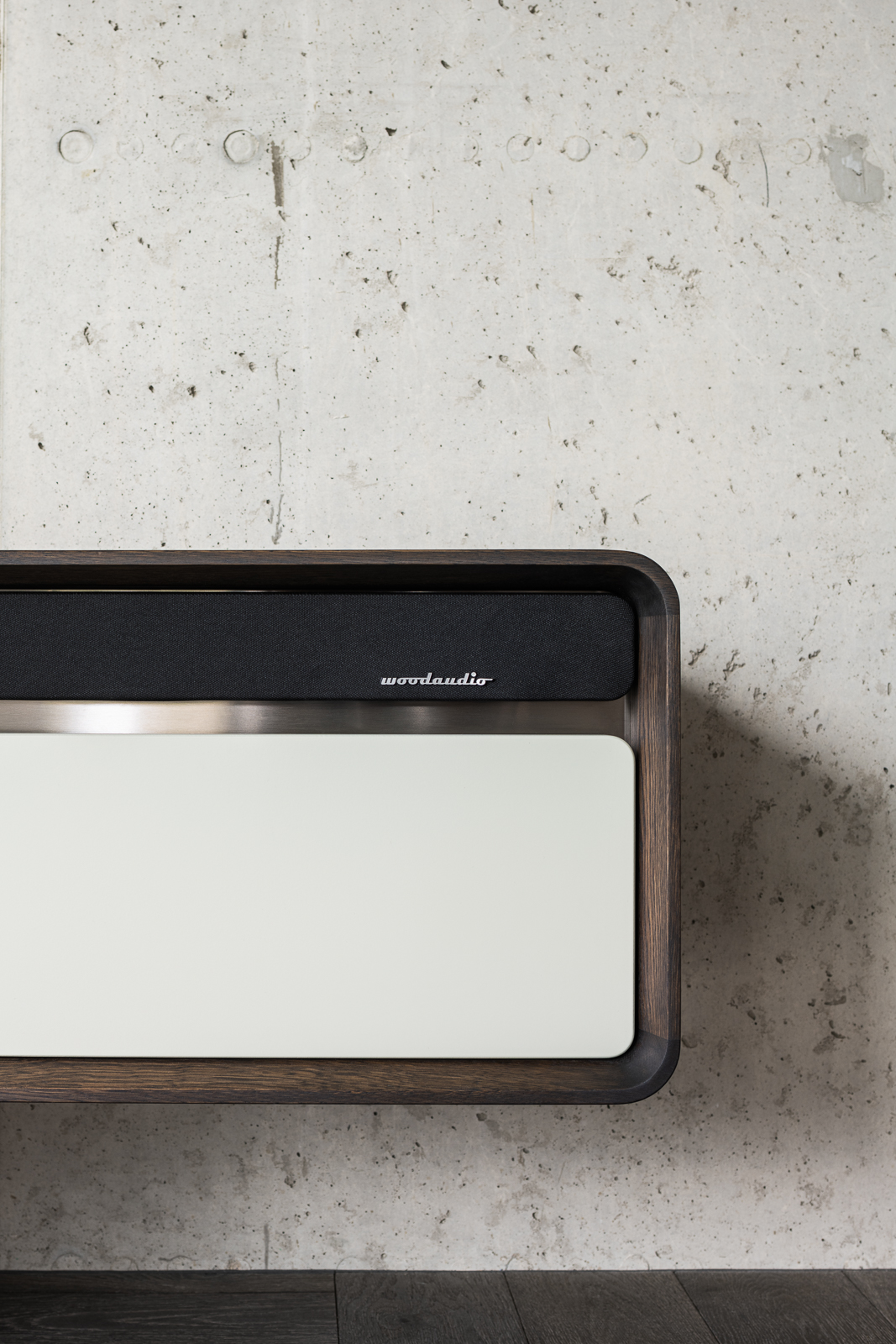
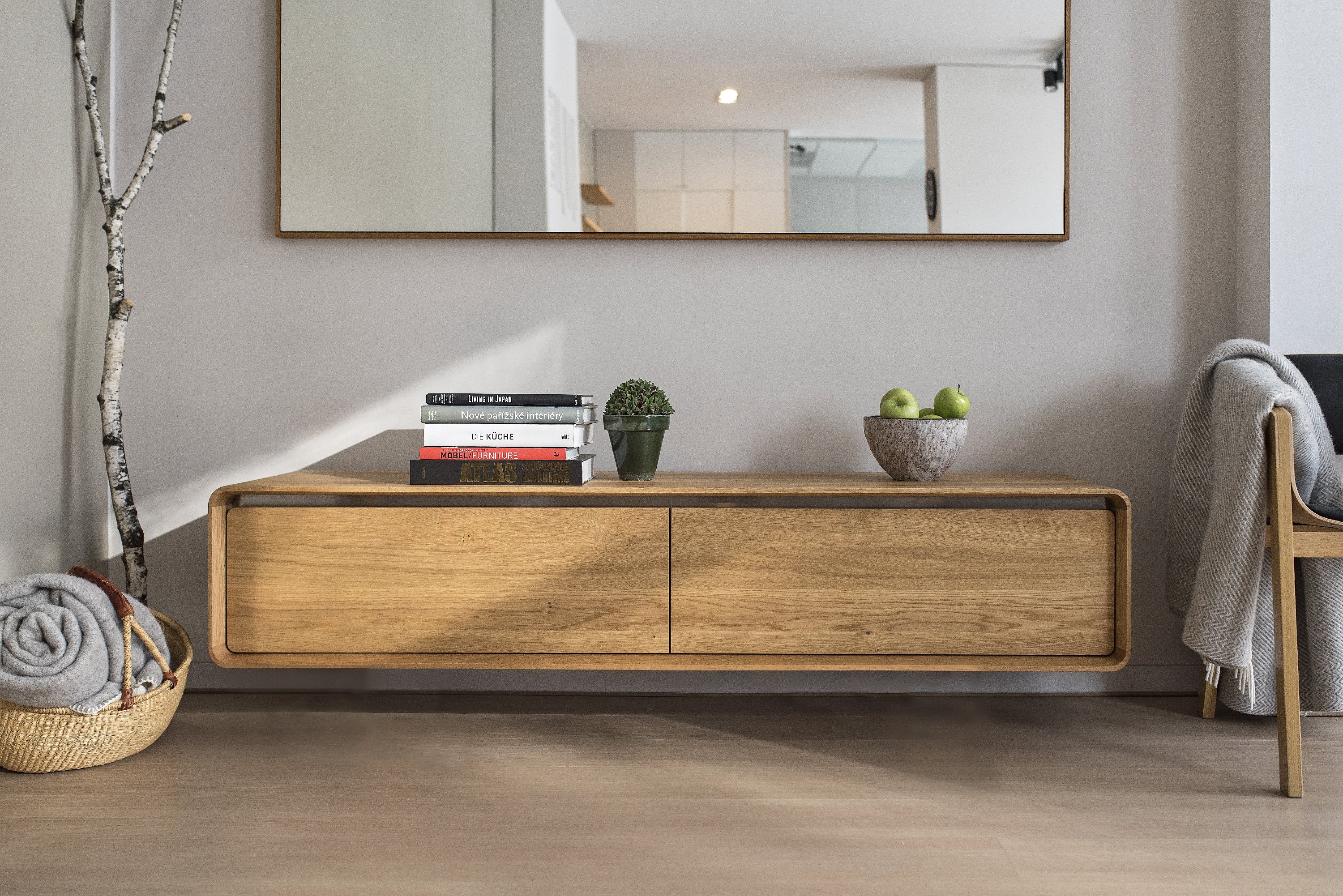
Televisions are sold by diagonal measurement, but the number that determines console width is the horizontal one. For a standard 16:9 screen, multiply the diagonal by 0.87 to get approximate screen width, then add an inch or two for the bezel and any outward-splayed feet.
That gives you a working set of figures.
The console should never be narrower than the screen. A screen that overhangs its base looks unstable even when it is bolted to the wall behind. Aim for four to six inches of console on each side of the screen, which puts a 65-inch television on a console of roughly 65 to 69 inches, and a 75-inch television on something in the 73 to 77 inch range.
Depth matters less than people expect for the television itself and more than they expect for what goes inside. Measure your deepest component, usually an AV receiver or a games console, and add three inches of clearance behind it for cable bend radius and airflow.
The centre of the screen wants to sit close to your eye level when you are seated. Rather than working from an average, measure your own. Sit on the sofa you actually use and have someone measure floor to eye. Then take half the screen height, which for a 16:9 television is the diagonal multiplied by roughly 0.245, and subtract it from your eye height. The result is the console height you want.
Do the arithmetic before you shop. It is the single check that most often rules out a console people have already fallen for.
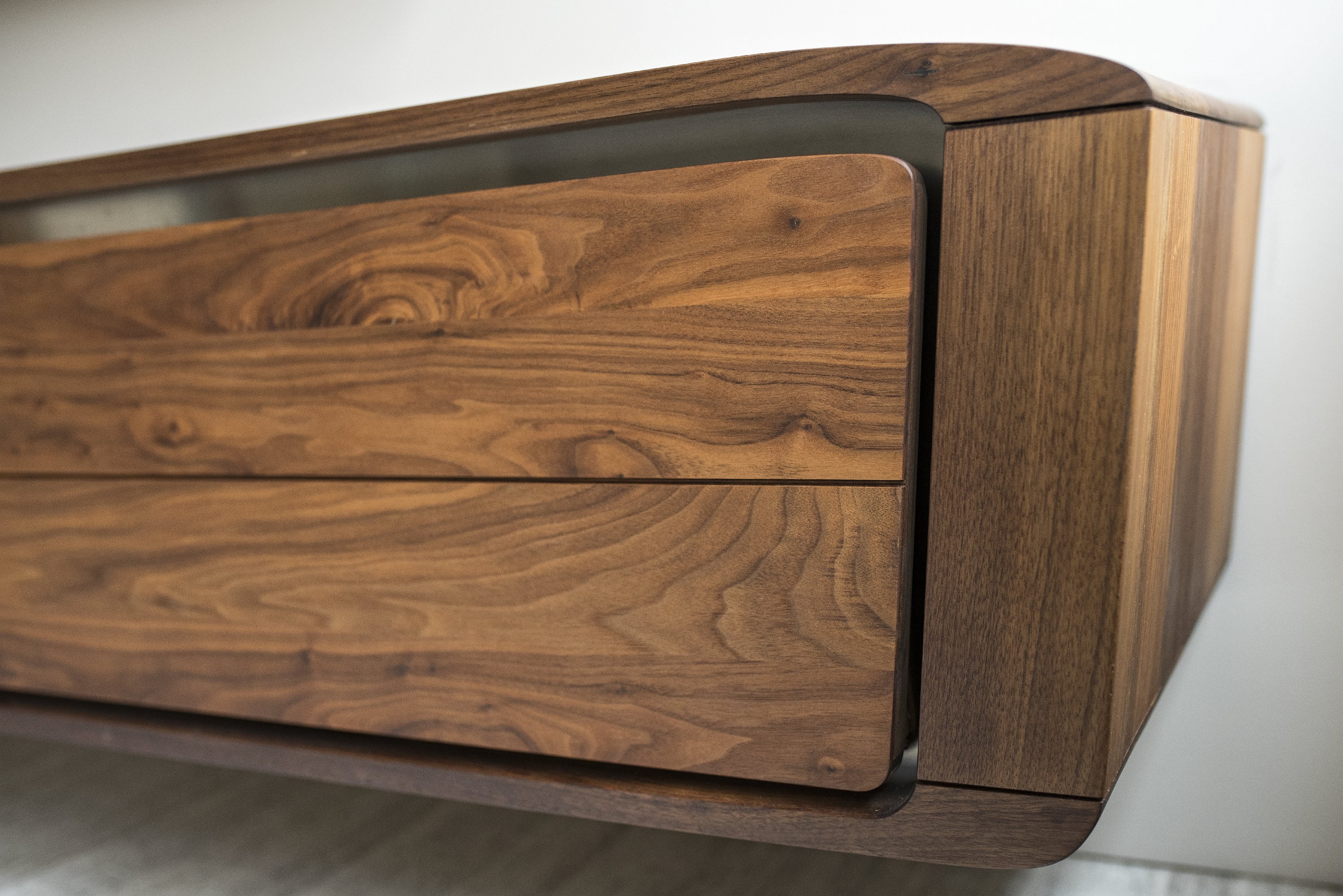
A wall-mounted console leaves the floor unbroken beneath it. The room reads larger, cleaning is easier, and the piece looks lighter than its actual mass. The trade-off is structural. The wall has to carry the cabinet plus everything you put in it, which rules out plain drywall and thin partition walls. Several models in the range are designed to be wall-mounted, and the instruction on those product pages is explicit about avoiding partition walls. Wall anchoring hardware is not supplied, because the correct fixing depends entirely on what your wall is made of.
A freestanding console on legs asks nothing of the wall and can be moved when you rearrange or relocate. On timber floors it also lets air circulate underneath, which suits rooms that swing between damp and dry across the year.
If you rent, or if the wall construction is unknown, choose legs. Retrofitting a mount later is straightforward. Patching a failed one is not.
Cable management is decided by cabinet geometry, so it belongs in the selection process rather than after delivery. Three questions settle most of it.
Where do the cables leave? Look for cut-outs in the back panel, and check they line up with where your outlet actually is. A cut-out on the wrong side of a 70-inch cabinet is a long detour for a power lead.
Is there room behind the components? A power strip lying flat behind your equipment needs its own depth allowance. Adding it to the component depth is what turns a comfortable fit into a cabinet that will not close.
Do the doors let signals through? Anything with an infrared remote needs line of sight or an IR repeater. Solid oak flap doors block infrared completely when closed. Drawers are best used for the objects you do not power, such as remotes, discs, controllers and spare cables.
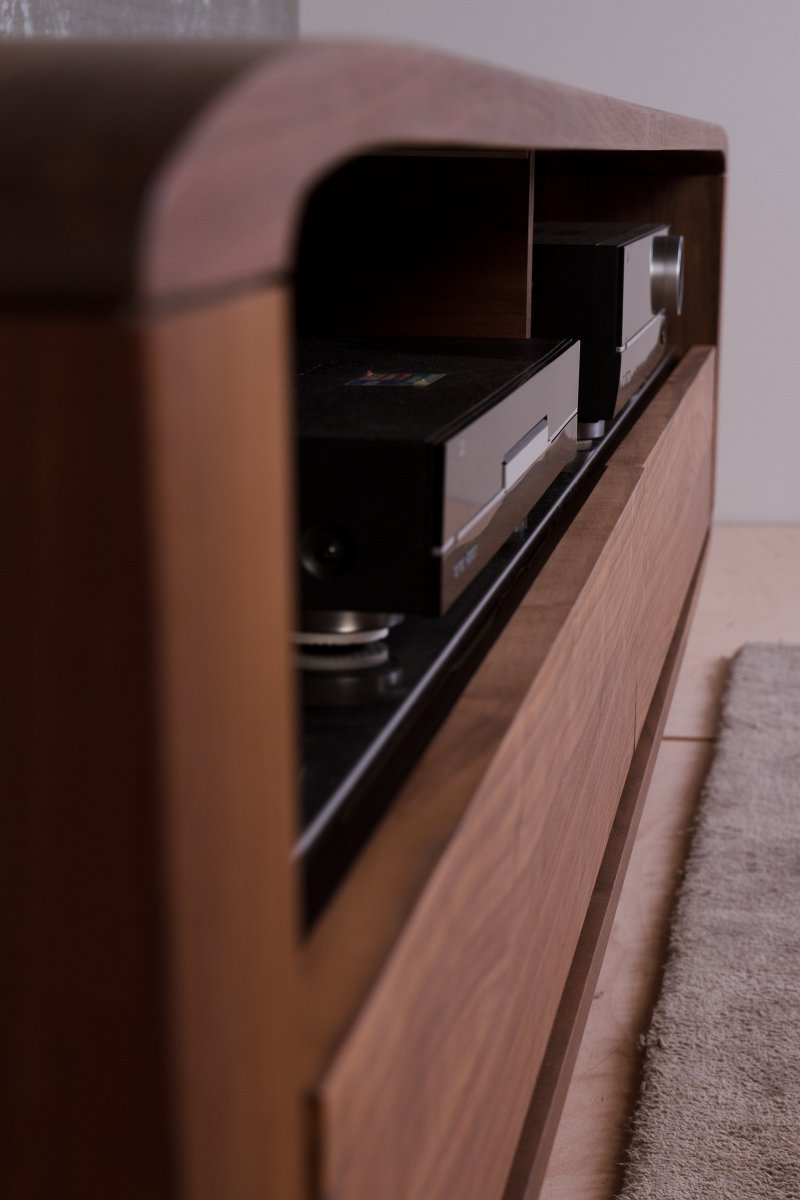
Heat is the constraint people underestimate. An AV receiver in a sealed compartment will run hot and shorten its own life. Leave the compartment vented, or keep the receiver outside the cabinet.
"Oak" in a product title tells you almost nothing. It may describe a solid oak carcass, an oak veneer over engineered board, or a printed foil that imitates oak grain. The three behave differently over ten years and cost differently to make.
Two terms worth keeping straight, because retailers blur them. MDF is made from wood fibres pressed with resin. Particleboard, also sold as chipboard, is made from larger wood particles. They are different materials with different densities and different screw-holding behaviour.
Veneer itself is not a shortcut. A thin slice of real oak bonded to a stable substrate is the correct engineering answer in specific places, particularly for wide flat panels where a solid board would expand and contract enough to crack or bow. The question is not whether veneer appears anywhere in a cabinet. It is whether solid wood is doing the structural and visible work.
BeOak builds every visible part of a media console in solid oak. Cabinet backs and drawer bottoms use oak-veneered MDF, deliberately, because those are exactly the wide thin panels where solid timber would move against its frame. You can read more about how we select and process the wood before it becomes furniture.
A manufacturer that knows its own process answers all four without hesitating. Vague answers to specific questions are the useful signal here.
Our pieces are sealed with a blend of linseed oil and natural wax rather than a film-forming lacquer. The difference shows in how the surface ages. An oiled finish sits in the wood instead of on top of it, so the grain stays readable under your hand and localised wear does not show as a chipped edge.
Standard finishes are Natur, White and Chocolate. Brown, Coffee and Dark Grey are available at a surcharge. Samples of every finish can be ordered before you commit, which is worth doing given how much the surrounding light in a room changes how a tint reads.
Oak darkens over time under UV light and oxidation, moving toward a warmer honey tone. This is normal behaviour rather than a defect, and it is why furniture bought two years apart in the same finish will not match on the day the second piece arrives. Give it a season.
For routine cleaning, use a dry or slightly damp soft cotton cloth. Avoid microfibre, which acts like a very fine abrasive on an oiled surface.
Wood movement is driven by moisture content, which tracks the relative humidity of the room. Temperature matters mainly through its effect on humidity rather than directly. A media wall is a demanding spot on both counts, since electronics push out dry heat and the console often sits on an exterior wall near a vent.
Two practical measures. Keep the console clear of a direct floor vent or radiator, moving it a foot to one side if that is what it takes. And run a hygrometer through your first heating season so you know what your room actually does, rather than what you assume it does.
Six configurations across three designs, all in solid oak, all made to order in our own workshop.
Every TV cabinet is delivered fully assembled, which spares you the awkward part of getting a wide carcass square on the floor of a finished room. Production runs 5 to 7 weeks, and each piece carries a 5 year warranty. Delivery, carry-in and installation by our own team can be arranged.
The full solid oak TV cabinet category shows current pricing and every finish option.
A 65-inch 16:9 television measures roughly 57 inches across, so the console should be at least that wide. A width of 65 to 69 inches gives four to six inches of visible console on each side, which is the proportion most people find balanced.
Yes, provided the wall can carry the load. Solid oak cabinets are heavy before you add equipment, so plain drywall and thin partition walls are not suitable. The correct fixings depend on your wall construction and are not supplied with the cabinet.
Solid oak is the better choice for the frame, top and visible fronts, because it can be sanded and refinished across a lifetime. Oak veneer over MDF is the better choice for wide thin panels such as cabinet backs and drawer bottoms, where solid timber would expand and contract enough to cause problems. A well-built cabinet uses both, in the right places.
Not exactly, and not immediately. Oak darkens under UV light and oxidation over its first few years, so a new piece will read lighter than one that has been in the room for a while. Ordering a finish sample and comparing it in your own light is the reliable way to check the starting point.
Route them through the cut-outs in the back panel toward your outlet, keep a power strip inside the cabinet rather than trailing leads to the wall, and allow around three inches of clearance behind components for the cable bend. Anything operated by an infrared remote needs either an open shelf or an IR repeater, because solid wood doors block the signal.
Production runs 5 to 7 weeks. Every piece is made to order, so a configuration that is not held in stock is still fully orderable and stock only shortens the timeline.
Yes. Chests of drawers, chairs and TV cabinets arrive fully assembled. Beds, tables and coffee tables arrive flat and typically need four screws.
Use a dry or slightly damp soft cotton cloth and deal with spills straight away. Do not use microfibre cloths on oiled surfaces, as they abrade the finish. For anything beyond routine cleaning, ask us before you treat the surface yourself.
If you are working on a client residence, our trade programme gives access to 3D model files on each product page, project pricing and a named contact. Apply to BeOak PRO, or book a showroom appointment to see the finishes in person before you specify them.